
Marek Straszewski tells Magdalena Komborska-Łączna about what is the starting point in his photography, what tools he uses, why he is interested in portraiture and what is the nude for him. The conversation revolves around his premiere exhibition AFTER ROSTS, which was originally to be titled AFTER ROST, and this is directly related to its relationship to the outside world.
What are you more interested in portrait or nude?
- I am interested in good photography. Portrait is my specialty, I started my adventure with photography from portraiture. I bought my first camera to take portraits of my friends. Portrait is my first choice, and nude is a portrait for me. I am interested in body movement, emotions. I am interested in the whole living person.
Since when have you been involved in body photography?
- It does not photograph the body, but its movement, its feeling, its emotion.
Is the nude always some kind of self-portrait for you?
- Yes, and even every portrait I take is a self-portrait for me.
What is your definition of portraiture?
- This is a frame from a record of the relationship between two people at a given moment.
Why to the last exhibition AFTER ROSTS you have portrayed yourself?
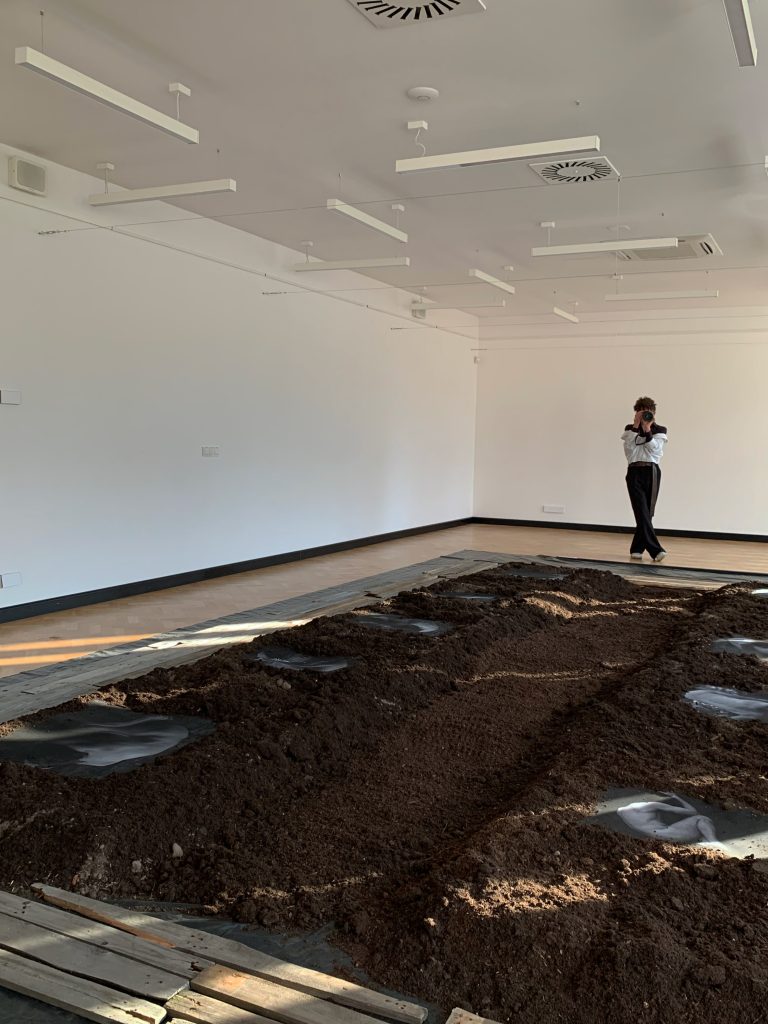
- I called this installation Lichen, and the curator Magda Komborska-Łączna added „Y”, this sign is a symbol of intimacy for me, which is very suitable for this exhibition. I wanted to talk about the relationship with myself, the need for liberation, about decay and flourishing, moving from one state to another at the level of body and mind. The earth, the fertilizer gave me an organic medium to immerse myself in this transition, this process I feel is uniquely organic. I couldn't use a body other than my own, because I wouldn't have felt it so deeply. I needed my body as a tool in this process it had to be my naked body in the ground in the fertilizer and passing into the fertilizer it was so obvious to me that it only occurred to me during the shooting that I would actually have to show up naked.
What does the exhibition title refer to?
The biggest difference is that technology and the internet has speeded everything up tremendously in just a few years. We take the instant transmission of photos and text for granted. As a photojournalist for 60 years, I well recall a different time when I would send packages of undeveloped rolls of film with hand written captions to editors all across the world. DHL and FedEx were vital for my international work, even the regular mail system on occasion. Then digital cameras and the internet came along, changing everything, and a lot more time had to be spent at the computer. Newspapers were the first to take advantage of the technology as they require a quick turnaround for news stories and photo quality was less demanding. It took longer for color magazines to adapt, the sort I worked with, who had to wait until digital photography improved. Online media didn't exist at all until relatively recently but it certainly didn't kill print media, as some predicted. LICHEN, LICHENS, is a state of transformation, an organic movement of overgrowth, decomposition, penetration.
At what point and how is the „natural act” created in your photography?
- It's like portraiture, it requires you to be in a situation where the camera becomes natural and then you can take a natural photo.
How would you interpret the words „human face, or divine image,” what is „human face” to you?
- The human face is interesting to me because it has so many imperfections, that it changes, transforms, is beautiful and ugly, strong and fragile, expresses emotions, soul, life. Perhaps in emotions we are closest to the creator? The image of the divine is even more of a mystery to me than God himself.
What kind of emotions do you convey in the photographs presented in the exhibition: a bond, a longing between the body and its nature, or maybe they are emotions directed to or from the body?
- Longing for nature, for organic feeling. The body in the photographs is in tension, feels some pain some discomfort, but it is in a phase of transition into something new, this gives hope. The photographs are part of the installation, the body is part of the installation, at this stage they do not work separately, they are blended into the earth and water and the processing. Emotions also change in this process, it's all alive. When the photographs are processed they will become the final result. For now, we can say that they are developed by an organic developer.

What do you use to take photographs, what is your photography tool?
- I understand that you are not asking about the camera, but about the way to create a good portrait. The tool can be anything that serves to evoke and catch a magical moment, during which shared emotions - mine and those of the person I'm photographing - are trapped and reanimated in the frame. A relationship is established, emotions are stirred, stimulated and recorded on the face or body. To achieve this you need to open up, if only for a fraction of a moment, to trust each other. Sometimes one smile helps, sometimes you need to bore someone a little, or change the music ☺.
Faced with the creations of today's mainstream, democratic photography, do you feel more comfortable in the skin of a photographer of useful public information, or do you rather expose it and commit a stunt to capture the shadow of a photograph with human intent?
- It's a good thing that everyone has the ability to take a picture, thanks to smartphones already probably anywhere and at any time. The problem is the choice. My task is to capture the light in a photograph of human nature.
Interviewed: Magdalena Komborska-Łłączna
Marek Straszewski - one of the most talented and recognized Polish photographers, for many years working with the most popular magazines, including „Elle”, „Glamour” and „Playboy”. He is the author of many advertising photos, including those for Dior, Kinder Bueno, Big Star, Toyota, Mercedes-Benz, Coca-Cola, and the creator of advertising campaigns for major jewelry manufacturers such as Apart in Poland and Wempe in Germany. Marek Straszewski's works have been presented in solo exhibitions: in 2007 at Warsaw's post-industrial PZO gallery and in 2008 at the Fibak Gallery. In 2023, Straszewski's exhibition was shown as part of the Mount Literature Festival. A year later at the Academic Design Center of the Academy of Fine Arts in Lodz in an exhibition 1 2000 2024 presented Straszewski's work over 25 years. By day, the artist runs his own photography studio in Warsaw.
Magdalena Komborska-Łączna - Producer and curator of exhibitions on the latest issues of art and design, publisher, author of monographic lectures Art in the city's public space For the University of A. Mickiewicz University in Poznan and Art promotion UAP in Poznań, curator of Gallery [ON] in Poznań. Founder and president of Publish Art and is currently working on a project FLUID BODIES from the series Design in Process At the Academic Design Center in Lodz, Poland.
Exhibition AFTER ROSTS
Artist: Marek Straszewski
Corporate identity: Mariusz Andryszczyk
Curated by: Magdalena Komborska-Łączna
6.06-31.08.2025
Academic Design Center
13/15 Księży Młyn Street, Łódź
Organizers: Academic Design Center, Academy of Fine Arts in Lodz,
Partners: PLESIAK PATRICIA, BUBALA, SZUM Magazine, I Do Art.
Media Patronage: Photography Quarterly
The exhibition was accompanied by scientific conference Stories of Body Creation.