

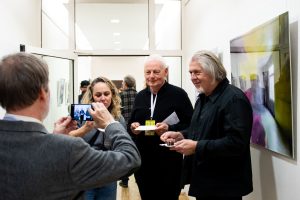
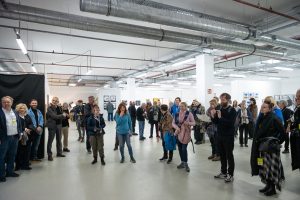
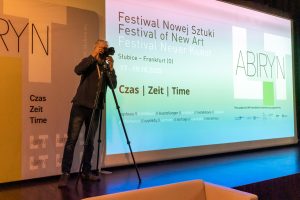
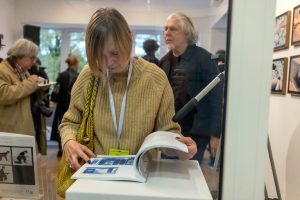
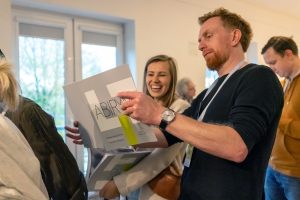
Slubice and Frankfurt/Oder have been going through difficult times this year. The bridge connecting these border cities has become an arena for political disputes. However, on October 17-19, thanks to art - New Art - one could see that more unites than divides here. And nothing indicates this fact better than the artistic activity promoted by the international, cross-border, ambitious and interdisciplinary New Art Festival lAbiRynT, which has been held here for 16 years.
The motto of this year's lAbiRynT was - how aptly chosen for the contemporary context - the following. Time. Anna Panek-Kusz and Michael Kurzwelly, curators of the festival, in their introductory texts define it as „traces of existence”, „tides”, at the same time opening up a whole palette of possible interpretations: from the technical arrest characteristic of the medium of photography, through metaphorical interpretations, to considerations based on the achievements of modern physics on its relativity - the existence of simultaneity, deceleration, deflection or dilation.
This year's lAbiRynT was thus a wandering through realizations provoked by or giving context to the passage of moments. What should be added - a wandering as much physical as, or perhaps above all, intellectual, supplemented by evening lectures and presentations.
It is impossible to describe every exhibition of the festival and refer to every work, since as many as 170 artists participated in the more than 50 events of this edition of lAbiRynT. Thus, the following selection will be based on the artist's own feelings and the conversations held - in other words, subjective. But perhaps that's what it should be: subjectivity is, after all, an inalienable, if not nurturing, feature of art reception.
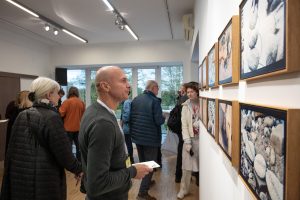
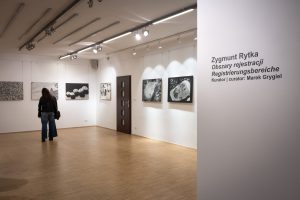
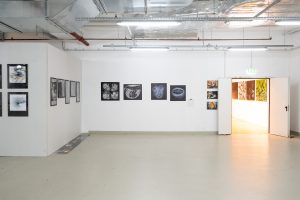
Areas of registration - the main exhibition of the festival under the curatorship of Marek Grygiel - presented a review of the works of Zygmunt Rytka. Arranged in the OKNO gallery of the Słubice Municipal Cultural Center, it perfectly introduced the theme of the festival with works and accompanying films from the series of Private collection, Continuity of infinity, as well as a visual presentation in the catalog: Some meetings, Time intervals, Contact or my favorite Instantaneous objects. Transformation project. The whole thing gave an excellent starting point in the multithreaded journey through the interpretations of time that viewers experienced later.
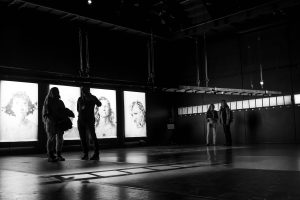
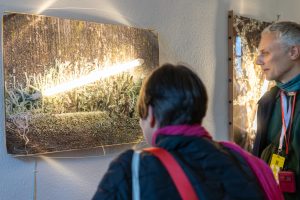
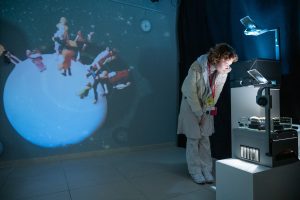
In the spaces of SMOK (Slubice Municipal Cultural Center), among the many interesting exhibitions, I particularly remembered the video installation Out of time By Harro D. B. Schmidt, in which - in addition to what it depicted and how it depicted it - the devices it uses were also important. „Finding projectors,” as the exhibition description reads, transmit light through various, sometimes set in motion, objects and liquids. The whole was complemented by melted clocks placed on the wall, evoking obvious associations.
Postponement by Doris Titze and Thomas Hellinger is an exhibition of works by artists transposing musical experiences into abstract imagery. In the case of Doris Titze's works, it was the traces of coal on paper, which could bring to mind the drawing of a variograph or seismograph, but which, combined with the music that could be listened to through headphones, seemed to chart the experience. Just as photography transforms chronological relations of events into compositional relations of projections of spatial objects, Doris Titze's works transform sounds flowing through time into observable „at once” compositions.
Large format Dream about Warsaw Karol Jaworowski, which at first brings to mind a Photosynthesis Krzysztof Pruszkowski, is also a story about the relationship with time. However, the syntheticity of these images is different from Pruszkowski's. In this case, the artist first shredded the exposure time and then combined it in slightly shifted multi-exposures of architectural objects. This is a reference not only to the passage of moments, but also to the way we remember - abbreviated, indistinct, emerging details only in fragments that our imagination recalls.
The second day of the festival began in the Urad Valley, where they presented, among other things, the atmospheric ceramic works of Magdalena Grzybowska, titled "The Art of the Urad Valley". Collections and River Time - water turntable Adrian Palka and Wolfram Spyra. In both expositions, one could find ideological associations with the exhibitions presented at the Areas of registration works by Zygmunt Rytka, although both presentations are, of course, autonomous works.
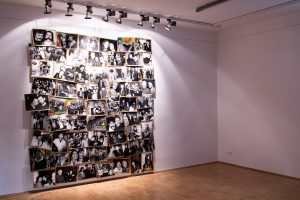
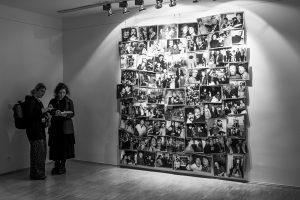
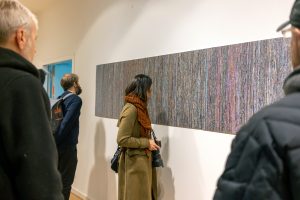
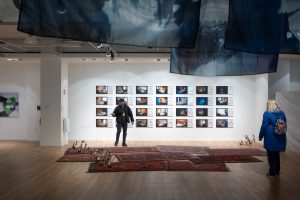
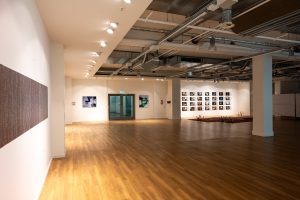
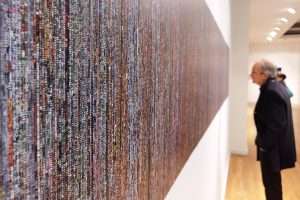
Another highlight of the lAbiRynT was the Magistrale Kunsthalle in Frankfurt, where the main exhibition was a group exhibition Dureriosum, and featured such artists as Bartek Jermolinski, Andrzej Dudek-Dürer, Anna Andrzejewska, Dorota and Marek Herbik and Marek Poźniak. Quite a lot of interest and subsequent conversations were also aroused by the work of Adam Czerneńko, not included in the aforementioned exhibition, titled "The work of Adam Czerneńko". Exposure time. It is a collage of miniature photographs taken by the author over 47 years - imperceptible even in terms of details. In his own words, they form „an unreadable noise, but behind each of its pixels there is a story, an object, a light (...)”.
It was also worth the time to visit the exhibitions at Galerie B in Frankfurt, which showcased, among other things, Peter Wolynski's research-based, intellectually stimulating exhibition titled "The World's Most Wanted". What is the world. The author presented photo-objects exploring the intersection of the semantics of text and photography, which in the age of images generated from textual prompts seems a particularly timely activity.
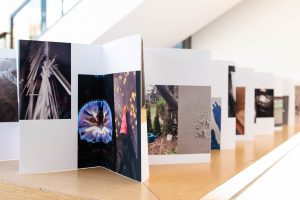
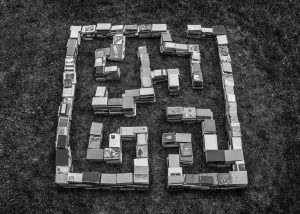
An integral part of each lAbiRynT is the Academy of Photography and Multimedia. It involves local photographers led by curators and invited presenters. This year the workshops were led by Anna Panek-Kusz, Michael Kurzwelly, georgia Krawiec and Krzysztof Slachciak - that is me. The results of these workshops could be seen in exhibitions at the Volkshochschule in Frankfurt/Oder. Each of the presenters presented a different, distinctive approach to the main theme of the festival.
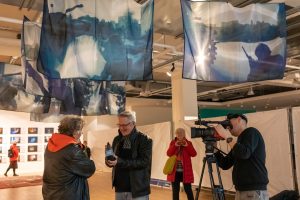
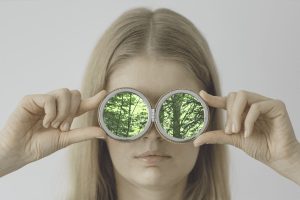
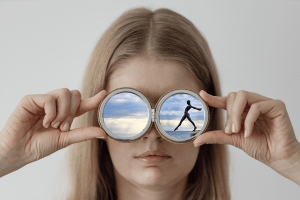
georgia Krawiec offered a workshop on observation through pinhole cameras, titled "The Observation of the Hole. Sometimes Słubfurt stands open. Seeing through the eyes of the city, during which participants built objects whose main goal was to create a pinhole projection on a surface or matte. Mobile objects were created that could be worn on the head, a camera with a matte that became an integral part of a shopping cart, and a stationary pinhole placed in a crack in a tree. The idea for the workshop, as well as the resulting objects, is a commentary on the process of seeing and the perceptual interpretation of an image. Those of the wearable objects were reminiscent of Ivo Kohler's famous experiment with reversing glasses - attempts to orient oneself in space based on an image not only inverted up-down and left-right, but also displayed on the opposite wall of the camera. It was possible to imagine that in just a few moments, hours, days the inverted image would become normal, and when the camera was removed from the head it would become inverted again.
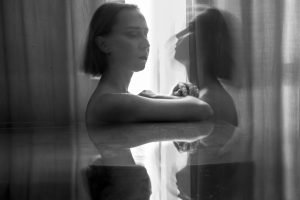
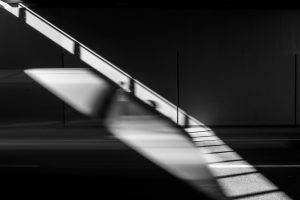
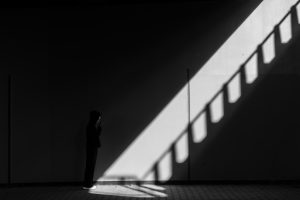
Anna Panek-Kusz led a workshop entitled. Timespace, the axis of which was the reflection on „the form of visualization of the passage of time.” Photography, through its feature of fluidity of recording time, seems to be a perfect tool for this, and the participants of the workshop made this perfectly clear with the use of motion, multi-exposure or photomontage. My attention was particularly drawn to the work of Katarzyna Skubisz, whose diptych showing a streak of light against a deep shadow may be associated with a sundial. Dariusz Olechno's montage, on the other hand, seems to be an attempt to show multiple stages of a character's life in a single frame. It is impossible to resist the impression of a reference to the tradition of Cubism, which, by the way, the workshop leader and curator writes about in her introductory text to the entire festival. It is also worth noting Anna Lysiak's works, which are abstracted by prolonged exposure time, which, apart from their aesthetic value, seem to be a visualization of dynamics brought to the point where it reaches the stillness of the flowing medium. Workshop Timespace were also studio experiments, where participants worked with body, movement and light. The works based their visuality on the play of contrasts, often associating themselves with the field of printmaking, which was particularly prominent in Natalia Janczycka's frames.
Michael Kurzwelly tasked his subjects with interpreting the theme The invention of time. The idea of the workshop brings to mind the saying „You have watches, we have time”, generally directed to representatives of Western cultures, emphasizing the differences in the experience of time in the rhythm of its absolute passage (Chronos) and lapse experiences (Kairos). Among the works presented, there was no shortage of cultural references: a work with sticky notes by Karin Zilske, a „stone” collage by Gudrun Kissinger or reliefs by Anja Schulze.
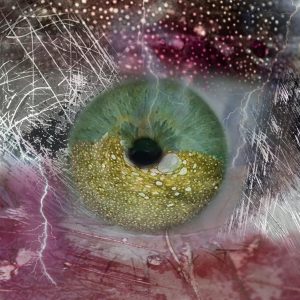
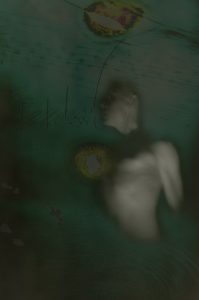
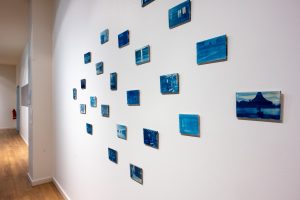
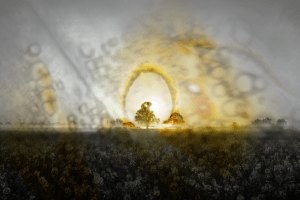
Title of the workshops I conduct Dilatation of states was inspired by the concept of time dilation, defining differences in the rate of its passage depending on the distance from the source of the prevailing gravity. The premise was to take a photograph that, in keeping with the nature of the medium, would be a recorded slice of the world, and then make his own manual modifications directly on the film or combine the resulting image with an abstract photogram made separately. This emphasis on the subjectivity of photography through the author's intervention was to create from the registered projection a hybrid image of stopped time and a stampede of creative activities happening in individually perceived time and being the sum of one's own experiences. The clichés were scratched, drawn, melted and set on fire, and coherent and mature works emerged from these actions. Excellent examples are Witold Cholewa's set - a retrofuturistic journey to Mars (the text author's own association), Anna Panek-Kusz's symbiosis of digital and silver worlds, Kamil Mazur-Czerniecki's gestures, Tomasz Fedyshyn's work associated with constructivism, Eye Dariusz Olechno or photograms with only a shadow of reality by Gudrun Kissinger. The participants also proved that destruction can be the basis for actions with captivating, though sometimes disturbing aesthetics and mood, as shown in the work of Anna Lysiak, nudes by Karolina Konczynska, landscape by Agnieszka Wozna and natural forms by Anna Baherycz. At the opening of the exhibition I said - which I maintain in this text - that with such a group the main task of the presenter is not to disturb.
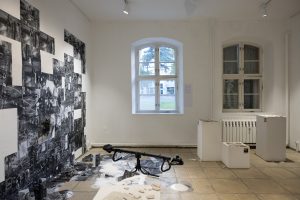
This year's Festival of New Art lAbiRynT ended on Sunday, when you could admire the work of, among others. Taran_25 Slawomir Sobczak in the Friedenskirche, and in the Kleistforum - exhibitions of students from as many as five universities, among which my attention was drawn to works from the set of Melancholy photography plant SWPS University students from Wroclaw. In addition, among the many excellent works, the exhibition by Ewa Martyniszyn juxtaposed with the object will remain in my memory Undermine Tomasz Drewicz and Esther Gronenborn's film, "The Future of the World. Institute.
Krzysztof Slachciak
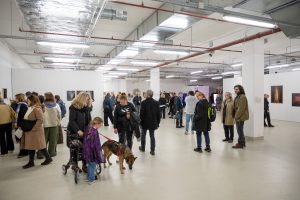
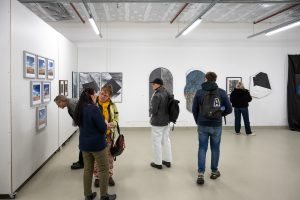
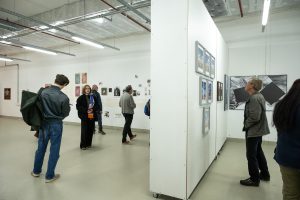
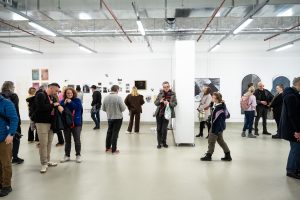
For more information about the lAbiRynT New Art Festival, visit labyrinth.slubice.eu. With the end of February, the organizers announce the slogan of the next edition and a competition for exhibition concepts, which can be submitted until the end of March.
SILENCE | STILLE | SILENCE is the slogan of the lAbiRynT Festival for 2026.
In this year's edition of the international art festival, artists are invited to reflect on the concept of „Silence.”.
We searched for a long time for a slogan that would be as strong as the Time of 2025, a term that is universal yet timely. In a time of social media, hate speech, political upheaval and climate change, SILENCE can be read as an invitation to stop, as an objection to emotional noise and hasty judgments. SILENCE as a pause, as a stop, as a state, as nothing, as the calm before the storm, as the snow covering everything, as a look at the stars, as attentiveness, as withdrawal, listening and perceiving, as the abolition of ignorance....
Silence is a space where something can happen. It is a breath between words, a pause between gestures, a moment of suspension. It can be uncomfortable, and sometimes louder than shouting.
It is a state of mindfulness in which the world slows down and the senses sharpen. It is also an ambiguous experience: it can soothe, but it can disturb; it can be a choice or a compulsion; it can protect or exclude. In silence, what is usually left by the wayside is revealed: a trace, a remnant, an echo.
We invite you to submit artistic proposals that engage in a dialogue with the slogan SILENCE in an open, personal and critical way.
Exhibition proposals should be sent to the festival curators by 31.03.2026
Anna Panek-Kusz: [email protected]
Michael Kurzwelly: [email protected]